
 Ankur Raghav
 Escalation in the Gulf raises fears of wider conflict and energy shocks.
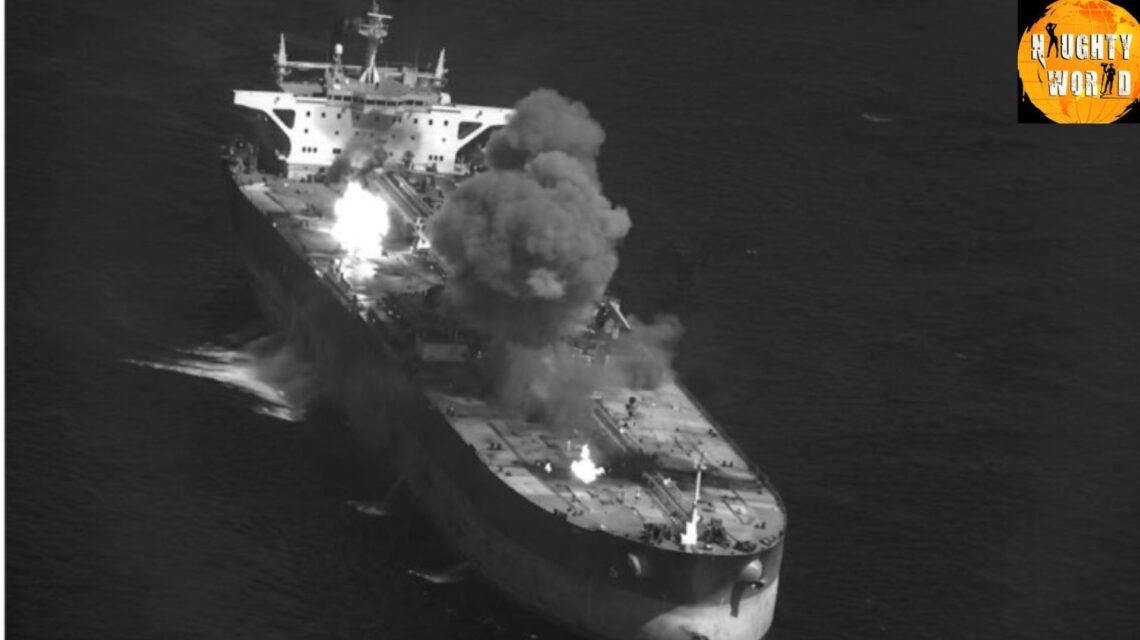
The United States military announced Tuesday that it had destroyed five Iranian crude oil tankers in the Persian Gulf, following repeated attempts by Iran’s Revolutionary Guard to target an American warship with ballistic missiles. The strikes mark another sharp escalation in a conflict that has dragged on for more than six months, threatening both regional stability and global energy supplies.
According to US Central Command, the warship successfully evaded two missile attacks in recent days before retaliatory strikes were carried out against Iran’s oil fleet. Iranian state television confirmed that several tankers were hit near the southern port of Jask and Kharg Island, with crews evacuated safely by lifeboat. Explosions were also reported off Yekbeni, though details remained unclear.
Speaking during a visit to Colombia, Secretary of State Marco Rubio warned that Washington would continue to respond forcefully. “Iran keeps trying to hit US naval ships. Every time they do, they’re going to lose tankers,” he said, signalling that further military action could follow.
Iran’s Revolutionary Guard Navy issued its own warning, telling crews of tankers near Kuwait and Bahrain to abandon their vessels. It accused both countries of aiding US forces, raising concerns that the fighting could spread beyond Iranian waters. Tehran has also threatened to declare a new “exclusion zone” in the Strait of Hormuz, a vital shipping lane through which nearly one‑fifth of the world’s oil once passed.
The confrontation is not limited to the battlefield. On Tuesday, the Trump administration expanded sanctions against Iran’s aviation sector, targeting more than two dozen airlines and cargo operators to isolate Tehran from international trade. The dual military and economic campaign reflects Washington’s strategy of squeezing Iran’s economy while maintaining control of Gulf shipping routes.
Global markets reacted swiftly. Brent crude briefly surged to $99.46 a barrel, underscoring energy supplies’ vulnerability to the conflict. Analysts warn that continued escalation could push prices higher, complicating President Trump’s political standing ahead of November’s midterm elections.
Security experts caution that neither side can impose a lasting solution through force. “Every attempt to impose one only brings Washington and Tehran closer to an escalation that may become increasingly difficult to control,” noted Danny Citrinowicz of Israel’s Institute for National Security Studies.
With tankers burning and sanctions tightening, the standoff shows no sign of easing. Both nations appear determined to assert dominance over one of the world’s most strategic waterways, leaving diplomacy struggling to keep pace with events at sea.

 Mortgage rates are rising each day; recently, they are nearly 6.91%
  Xi Jinping’s India visit signals diplomatic reset.
  Iranian strike damages US warplanes in Jordan.
  UAE’s warning ignored: Netanyahu under fire over Hamas attack.
  Singapore confronts online racism amid rising Xenophobia.
  The five-storey building collapsed in Satya Niketan on Sunday in Delhi.