
 Ankur Raghav
 Beijing’s fifth-generation jets signal routine high-altitude operations, while India’s response remains years away.
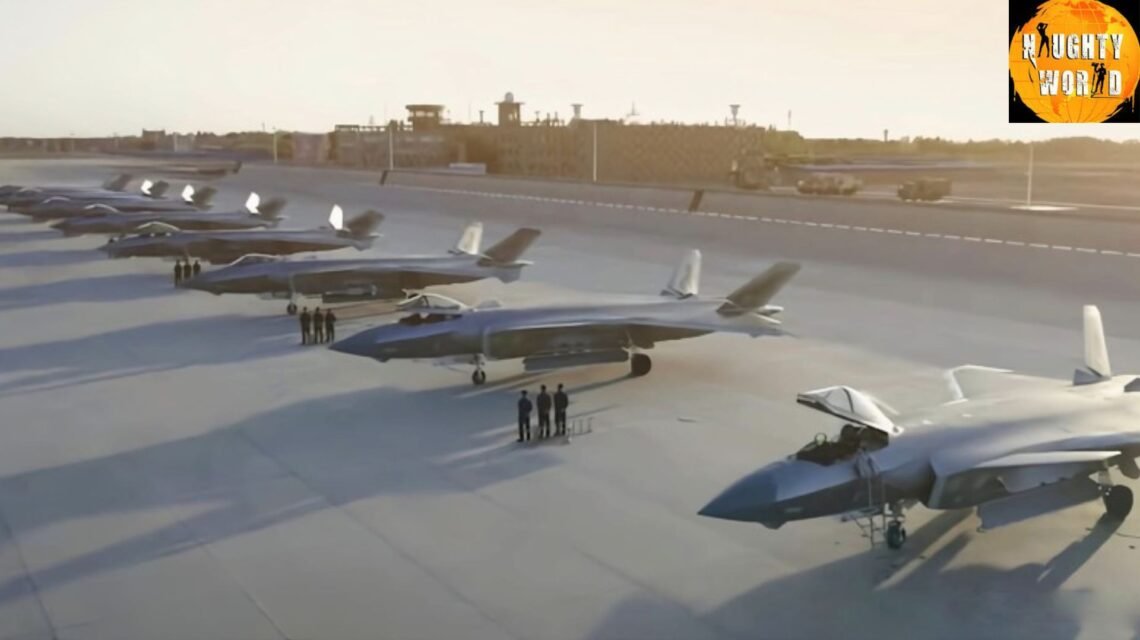
Recent satellite imagery has revealed a significant escalation in China’s airpower posture along the Himalayan frontier. At least eleven J-20 “Mighty Dragon” stealth fighters were spotted across two bases in Xinjiang and Tibet, marking the largest deployment of these advanced jets against India to date.
On July 9, seven J-20s were positioned at Hotan airbase in Xinjiang, located less than 400 kilometres from Ladakh. Another four were observed at Damxung in Tibet, northwest of Arunachal Pradesh. Analysts emphasize that these sightings confirm the People’s Liberation Army Air Force (PLAAF) is now conducting routine fifth-generation operations from high-altitude bases, rather than symbolic displays.
The J-20’s stealth shaping and minimal radar signature give China a decisive advantage in contested airspace. Unlike India’s current fleet of Rafales and Sukhoi-30MKIs, the J-20 is designed to evade detection and dominate aerial engagements. For the Indian Air Force (IAF), this means counter-stealth radars, integrated air defence systems, and long-range strike capabilities must become urgent priorities.
China’s rapid production capacity further compounds the challenge. From an estimated 50 aircraft in 2019, the J-20 fleet has surged to between 300 and 500 by mid-2026, with annual output exceeding 120 jets. Projections suggest Beijing could field nearly 1,000 stealth fighters by 2030, a scale unmatched in Asia. Retired Air Marshal Narmdeshwar Tiwari notes that such industrial efficiency reflects a national mission, backed by integrated supply chains and advanced manufacturing tolerances.
India, by contrast, remains years away from fielding its own stealth platform. The indigenous Advanced Medium Combat Aircraft (AMCA) is still in development, with operational service unlikely before the mid-2030s. Current capabilities rest on 36 Rafales spread across two squadrons, supplemented by over 260 Sukhoi-30MKIs and older Mirage 2000s and MiG-29s. Negotiations are underway for 114 additional Rafales, a deal valued at up to $40 billion, but these remain fourth-generation fighters without stealth features.
The deployment of J-20s at Hotan and Damxung underscores a widening technological gap between the PLAAF and IAF. For New Delhi, bridging this divide will require accelerated procurement, deeper defence partnerships, and a relentless focus on indigenous R&D. Until then, China’s stealth advantage along the Himalayan frontier is set to remain a defining feature of the regional airpower balance.
The deployment of J-20s at Hotan and Damxung underscores a widening technological gap between the PLAAF and IAF. For New Delhi, bridging this divide will require accelerated procurement, deeper defence partnerships, and a relentless focus on indigenous R&D. Until then, China’s stealth advantage along the Himalayan frontier is set to remain a defining feature of the regional airpower balance.

 Mortgage rates are rising each day; recently, they are nearly 6.91%
  Xi Jinping’s India visit signals diplomatic reset.
  Iranian strike damages US warplanes in Jordan.
  US strikes Iranian tankers after warship attacks.
  UAE’s warning ignored: Netanyahu under fire over Hamas attack.
  Singapore confronts online racism amid rising Xenophobia.